

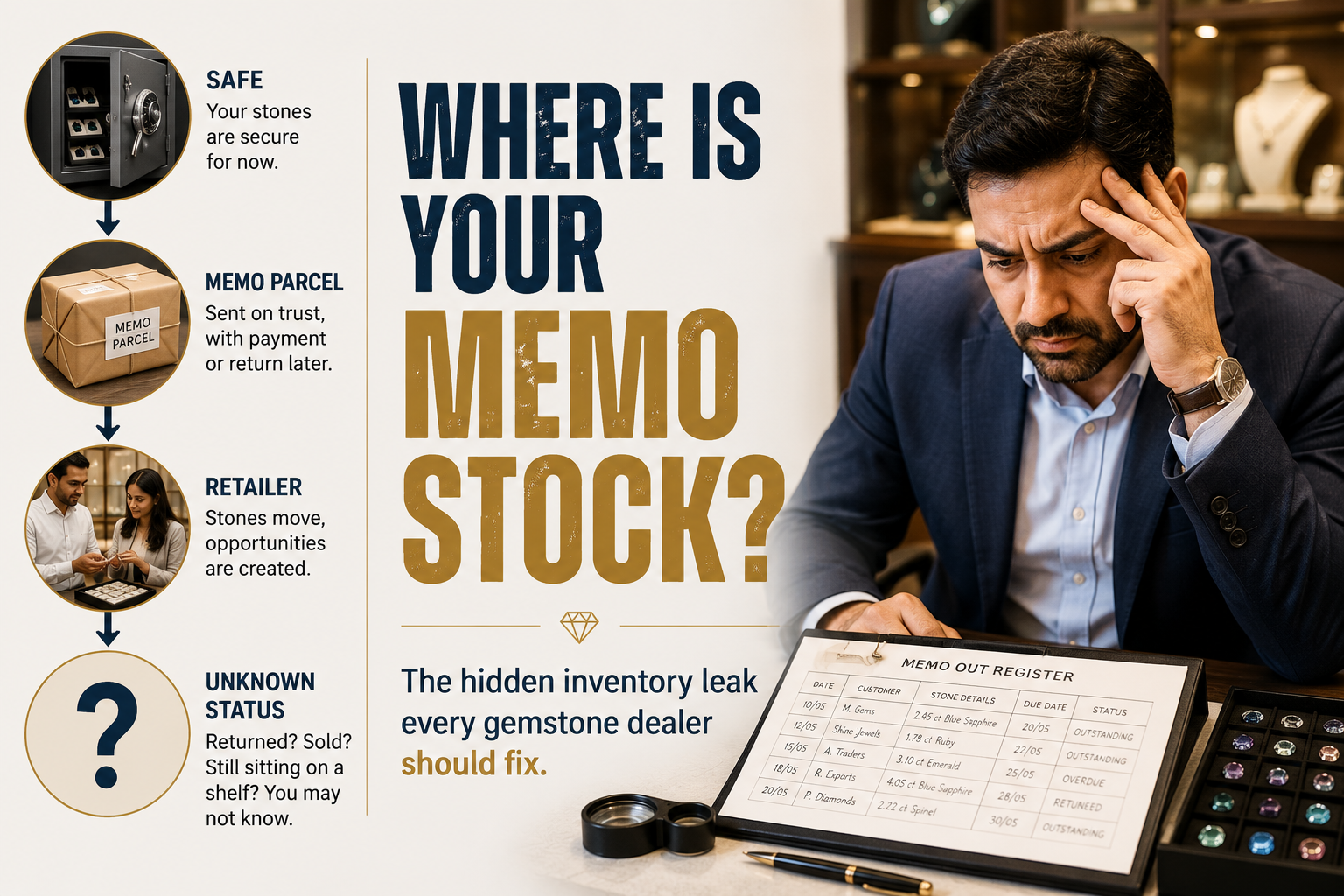
How Poor Memo Tracking Costs Gemstone Dealers Thousands Every Year
Ask any gemstone dealer where every stone in their business is right now, and watch the pause.
Somewhere between the safe, the showroom, and the three memo parcels sent out last month, the honest answer is often:
“I’m not entirely sure.”
That uncertainty may seem small, but over time it becomes one of the biggest hidden costs in the gemstone business. A single forgotten memo may not hurt much. Dozens of forgotten memos spread across months can quietly drain profits, create customer disputes, and make inventory impossible to trust.
The gemstone industry has always been built on relationships. Trust is essential. But trust alone cannot replace a reliable tracking process.
Quick Takeaways
- Memo stock allows gemstones to be sent without immediate payment.
- Poor memo tracking creates hidden inventory losses and cash flow issues.
- Every memo should include complete stone details, recipient information, due dates, and written acknowledgment.
- Weekly reconciliation helps identify problems before they become expensive.
- Consistent processes protect both inventory and business relationships.
At a Glance
| Question | Answer |
|---|---|
| What is a gemstone memo? | A gemstone sent to a buyer without immediate payment. |
| Biggest business risk | Losing visibility over outstanding inventory. |
| Best practice | Record every memo with customer details and return dates. |
| Review frequency | Every week. |
| Long term benefit | Better cash flow, accurate inventory, and stronger customer trust. |
What Is a Memo in the Gemstone Industry?
A memo is one of the oldest and most trusted business practices in the jewelry and gemstone trade.
Instead of purchasing a gemstone immediately, a retailer or buyer receives the stone on approval. They may show it to customers, compare it with other inventory, or attempt to sell it before deciding whether to purchase or return it.
This system offers several advantages.
- Buyers can offer a larger selection without purchasing every stone upfront.
- Dealers can place inventory into more markets.
- Business relationships become more flexible.
- Sales opportunities increase.
However, every benefit comes with responsibility.
The moment a gemstone leaves your office on memo, it becomes inventory that is no longer physically under your control. Without proper documentation and follow up, visibility quickly disappears.
Recording accurate gemstone descriptions is one of the simplest ways to reduce disputes and improve inventory accuracy. Details such as gemstone type, weight, measurements, treatments, origin (when applicable), and certificate numbers should follow recognized Gemological Institute of America (GIA) gemstone identification standards, making it easier for both buyers and sellers to verify each stone throughout the memo process.
Why Memo Tracking Becomes Difficult
Most inventory problems do not happen because people are dishonest.
They happen because businesses become busy.
Common reasons include:
- Multiple memo parcels sent to different clients.
- Return dates agreed verbally.
- Follow ups forgotten during trade shows.
- Returned stones not marked back into inventory.
- Missing paperwork.
- Different staff members handling the same memo.
- Inventory records updated days or weeks later.
- WhatsApp conversations replacing proper documentation.
Each issue seems minor on its own.
Together, they create significant inventory uncertainty.
Where the Money Actually Disappears
Inventory losses rarely happen through one dramatic event.
Instead, they happen through dozens of small mistakes that accumulate over time.
For example:
- A memo leaves without a scheduled follow up.
- The customer keeps the parcel longer than expected.
- Payment discussions are delayed.
- Returned stones sit on someone’s desk waiting to be logged.
- Inventory reports become inaccurate.
- Sales teams accidentally offer stones that are no longer available.
- Accounting struggles to determine which stones have been sold.
The financial impact extends beyond missing gemstones.
Poor memo management can lead to:
- Delayed cash flow.
- Lost sales opportunities.
- Inventory discrepancies.
- Time spent investigating missing stock.
- Customer disputes.
- Reduced confidence in inventory records.
A Real World Scenario
Imagine a dealer sends five sapphires to a retailer on memo.
Two stones are sold.
One is returned.
Two remain with the retailer.
Several weeks later, another employee takes over customer communication.
Nobody remembers which parcel contains which stones.
The paperwork is incomplete.
Emails are scattered.
WhatsApp messages contain only partial information.
The finance team is unsure whether payment is due or the stones are still on approval.
Hours are spent reconstructing the transaction.
This situation happens far more often than most businesses admit.
Best Practices for Managing Memo Inventory
A disciplined process dramatically reduces these problems.
Every memo should include:
- Complete gemstone description.
- Certificate number.
- Weight and measurements.
- Photos of the stone.
- Customer name and company.
- Date issued.
- Expected return or payment date.
- Written acknowledgment or signature.
Operational best practices include:
- Schedule reminders two days before due dates.
- Review outstanding memos every week.
- Audit inventory every month.
- Keep digital records alongside physical documentation.
- Assign one owner responsible for every memo transaction.
- Update inventory immediately when stones are returned.
Consistency matters more than complexity.
A simple process followed every time is better than an advanced process followed only occasionally.
Strong inventory documentation is not just an operational best practice. It also supports the professionalism and transparency encouraged across the global gemstone trade. Organizations such as the International Colored Gemstone Association (ICA) promote ethical business practices and greater confidence between gemstone dealers, suppliers, and buyers, making accurate record keeping an important part of long term business success.
Common Memo Tracking Mistakes
Many losses can be traced back to avoidable habits.
Watch out for these common mistakes:
- Relying only on verbal agreements.
- Forgetting to set return dates.
- Missing customer signatures.
- Tracking inventory in multiple spreadsheets.
- Delaying inventory updates.
- Skipping weekly reconciliation.
- Depending entirely on memory.
- Mixing sold inventory with memo inventory.
Even experienced businesses can develop these habits over time.
Recognizing them is the first step toward fixing them.
Frequently Asked Questions
What is a memo in the gemstone industry?
A memo is an agreement that allows a buyer to receive gemstones without making immediate payment. The buyer later returns the stones or purchases them according to the agreed terms.
Why is memo tracking important?
Memo tracking helps businesses know where every stone is, who has it, when payment is due, and when inventory should return.
What information should every memo include?
Every memo should record gemstone details, certificate numbers, customer information, issue date, return date, and written acknowledgment.
How often should memo inventory be reviewed?
Weekly reviews are recommended because they identify overdue memos before they become expensive problems.
What are the biggest risks of poor memo management?
The biggest risks include lost inventory, delayed payments, inaccurate stock records, customer disputes, and reduced cash flow.
Can digital inventory systems improve memo management?
Yes. Digital inventory systems make it easier to track outstanding memos, automate reminders, maintain accurate records, and reduce manual errors.
Key Takeaways
If you remember only a few things, remember these:
- Trust is valuable, but documentation protects trust.
- Every memo should have complete records.
- Follow up before due dates, not after.
- Review outstanding memo inventory every week.
- Small tracking improvements prevent large financial losses.
Final Thoughts
For decades, gemstone dealers have relied on memo trading because it creates opportunities for both buyers and sellers.
The system itself is not the problem.
The problem begins when inventory disappears into a process that no one can clearly see.
Whether you manage ten memo parcels a month or hundreds, building consistent tracking habits protects your inventory, improves cash flow, and strengthens the relationships that keep the gemstone trade moving forward.
The dealers who experience the fewest losses are rarely the luckiest.
They are simply the ones who always know where every stone is.
Looking for more insights on? Follow us for practical guides, industry best practices, and strategies to help you protect inventory, streamline operations, and grow your business with confidence.